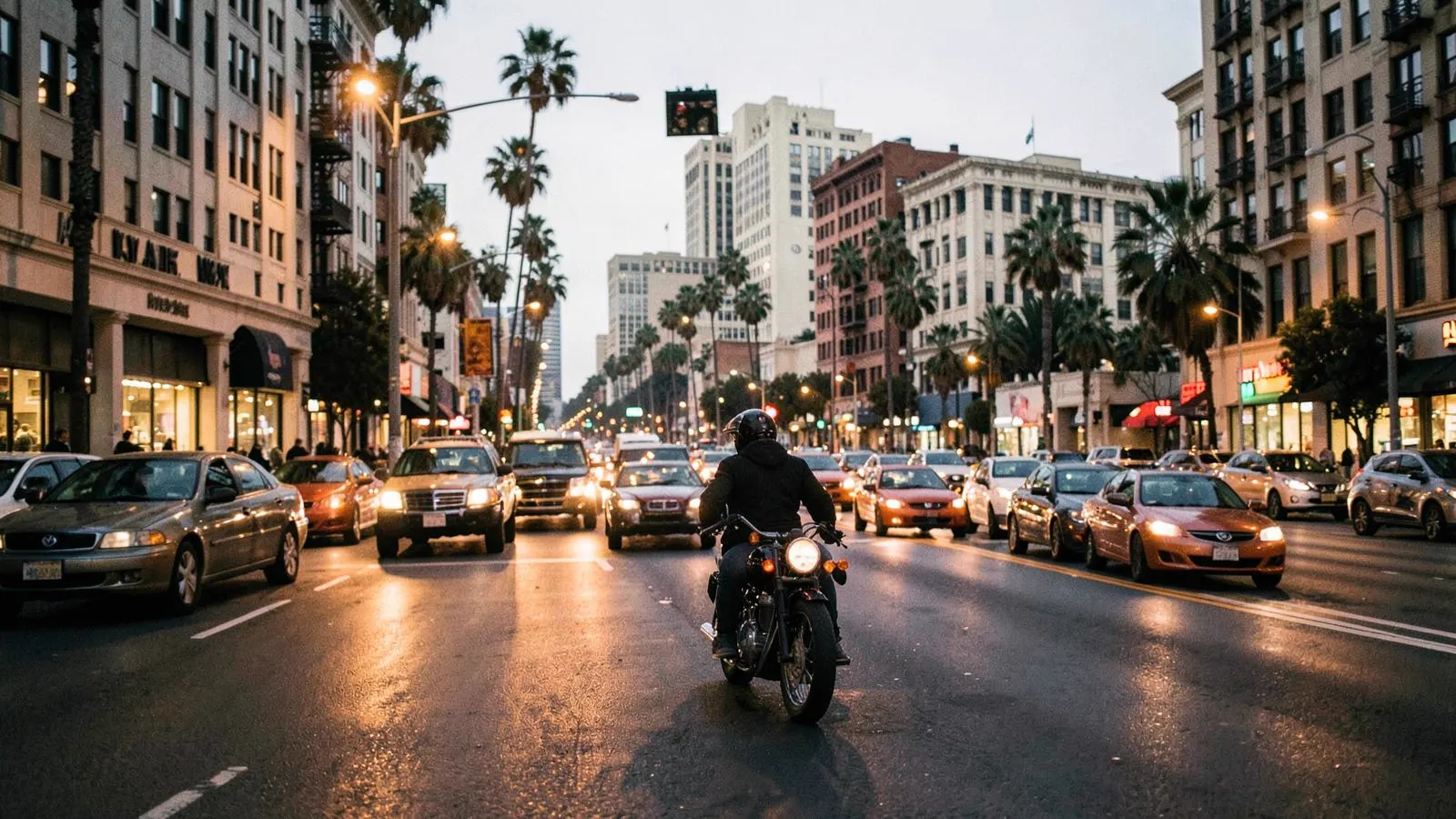
No supplied crash data identifies which Mid-Wilshire roads are most dangerous for motorcycle riders. Wherever a crash occurs, California law may let an injured rider seek payment from those responsible.
Two of the ten highest-scoring intersections on Los Angeles' citywide motorcycle High Injury Network sit inside Mid-Wilshire: 3rd Street at La Brea Avenue, ranked third in the city, and La Brea Avenue at Olympic Boulevard, ranked eighth. La Brea Avenue itself — from Edgewood Place north to Second Street, a 1.3-mile stretch — is the eighth-ranked motorcycle corridor in Los Angeles.
Which Mid-Wilshire Roads Are Most Dangerous for Motorcycle Riders?
LADOT's 2024 Vision Zero Safety Study scores streets across Los Angeles for killed-and-severe-injury collisions and publishes the highest-scoring ones as the High Injury Network. Three Mid-Wilshire locations appear on the motorcycle-specific version of that network, which is unusual for a neighborhood this size.
Mid-Wilshire also carries about 6.1 miles of the all-modes High Injury Network. The longest stretches are Olympic Boulevard (1.7 miles), La Brea Avenue (1.1 miles), Crenshaw Boulevard (1.1 miles), 3rd Street (0.8 miles), Fairfax Avenue (0.7 miles) and Wilshire Boulevard (0.5 miles).
One caveat matters when reading these rankings. Being on the High Injury Network means LADOT scored that segment among the highest in the city for serious-injury collisions. It is not a count of crashes on that block, and it does not mean a crash there was anyone particular's fault.
Traffic volume alone does not explain the pattern. LADOT's 2024 study lists 3rd Street, from Crescent Heights Boulevard to Figueroa Street — a run that crosses Mid-Wilshire — among the twenty corridors with the largest change in killed-or-severely-injured collisions, dropping from 56 such collisions between January 2017 and February 2020 to 15 between March 2020 and December 2021.
If you ride these streets regularly, the practical takeaway is narrow: intersections on La Brea, 3rd and Olympic are where the city's own data says riders are most often seriously hurt.
Why Motorcycle Crashes Happen
A motorcycle crash can happen when a driver turns across a rider’s path, changes lanes without checking, follows too closely, runs a light, or opens a vehicle door into traffic. Road defects or unsafe vehicle parts may also contribute.
Motorcycles offer little protection in a collision. Even when a rider is wearing safety gear, the impact can cause serious injuries and require long-term medical care.
Who May Be Responsible?
Responsibility depends on what each person did before the crash. A driver, vehicle owner, employer, parts manufacturer, or government entity may be liable in the right circumstances.
Evidence may include photographs, video, witness accounts, vehicle damage, medical records, and electronic data. Because evidence can disappear quickly, it helps to preserve it as soon as you can.
What if I was partly at fault?
California follows pure comparative negligence. You can still recover damages if you share blame, but your recovery is reduced by your percentage of fault.
Do not accept an insurer’s claim that you caused the crash without reviewing the evidence. Riders are sometimes blamed based on assumptions rather than facts.
How Long Do You Have to Bring a Claim?
California generally gives you two years from the injury date to file a personal injury lawsuit (CCP §335.1). Different rules or shorter deadlines may apply in some situations.
If a public entity may be responsible, such as when a dangerous public roadway contributed to the collision, you generally must present a government claim within six months (Government Code §911.2). Missing a deadline can prevent you from pursuing compensation, so early legal advice matters.
What Determines the Value of a Motorcycle Accident Claim?
No formula can tell you what a Mid-Wilshire motorcycle claim is worth. Its value depends on your injuries, treatment, recovery time, lost income, future care needs, pain, emotional harm, property damage, and how the crash changed your daily life.
Liability evidence and available insurance coverage also matter. If you share fault, California’s comparative negligence rule may reduce what you recover.
A fair evaluation usually requires time. Settling before doctors understand your prognosis can leave future treatment or lasting limits unaccounted for.
Dealing With Insurance Companies
An insurance adjuster may ask for a recorded statement, broad medical authorization, or quick settlement. You do not have to guess about your injuries or accept an offer before you know the full impact of the crash.
Keep communications brief and factual. Avoid posting about the collision, your activities, or your recovery online because insurers may use those posts to challenge your claim.
What to Do After a Crash
- Get to safety. Move away from traffic if you can do so without risking further injury.
- Seek medical care. Some serious injuries are not obvious right away. Follow your treatment plan and report new symptoms.
- Document the scene. If it is safe, photograph the vehicles, motorcycle, road, signs, traffic controls, debris, skid marks, and visible injuries.
- Exchange information. Get the driver’s name, contact details, license information, vehicle information, and insurance details.
- Find witnesses. Ask anyone who saw the crash for contact information.
- Preserve your gear. Keep your helmet, clothing, motorcycle parts, and damaged personal items in their post-crash condition.
- Track your losses. Save medical records, bills, repair estimates, receipts, and proof of missed work. Write down how pain and physical limits affect your routine.
- Speak with a lawyer early. A lawyer can protect evidence, handle insurer communications, identify responsible parties, and track filing deadlines.
Frequently Asked Questions
Can I recover compensation if I was not wearing a helmet?
Possibly. An insurer may argue that the lack of a helmet made certain injuries worse, but that does not automatically excuse the person who caused the crash. The medical evidence and connection between the helmet issue and your injuries will matter.
What if the driver says they never saw my motorcycle?
Failing to see a motorcycle does not automatically protect a driver from responsibility. Drivers must use reasonable care, check for nearby traffic, and make safe turns and lane changes.
Should I give the other driver’s insurer a recorded statement?
You should be cautious. The adjuster may ask questions designed to limit the insurer’s responsibility, and early symptoms may not reflect the full extent of your injuries. You can speak with a lawyer before giving a recorded statement.
What if a bad road condition caused my crash?
The entity responsible for the road may be liable if a dangerous condition contributed to the collision, but these cases have special rules. A government claim generally must be presented within six months (Government Code §911.2), so do not delay.
Can I make a claim if I was partly responsible?
Yes. Under California’s pure comparative negligence rule, you may recover damages even if you share fault. Your recovery is reduced according to your assigned percentage of responsibility.
How long do I have to file a motorcycle injury lawsuit?
California’s general deadline for a personal injury lawsuit is two years from the injury date (CCP §335.1). Some claims have shorter deadlines, including many claims involving public entities.
What if my injuries appeared after I left the scene?
Delayed pain does not prevent you from bringing a claim. Seek medical care promptly, explain when the symptoms began, and follow the provider’s instructions. Medical records can help connect those symptoms to the collision.
If you were hurt in a Mid-Wilshire motorcycle crash, Hollywood Injury Law Center — Bash & Polyachenko P.C. can review what happened and explain your options. Call (323) 850-0101 for a free consultation.
Intersection Crash Data — Mid-Wilshire
| Intersection | Crashes | Injuries | Fatalities | Data Period | Source |
|---|---|---|---|---|---|
| 3rd Street at La Brea Avenue | — | — | — | 2024 analysis | LADOT, Los Angeles Vision Zero Safety Study (January 2024), Priority Intersections — Motorcycle HIN |
| La Brea Avenue at Olympic Boulevard | — | — | — | 2024 analysis | LADOT, Los Angeles Vision Zero Safety Study (January 2024), Priority Intersections — Motorcycle HIN |
| La Brea Avenue, Edgewood Place to 2nd Street | — | — | — | 2024 analysis | LADOT, Los Angeles Vision Zero Safety Study (January 2024), Priority Corridors — Motorcycle HIN |
| 3rd Street, Crescent Heights Boulevard to Figueroa Street | 56 KSI (2017–Feb 2020), 15 KSI (Mar 2020–2021) | — | — | January 2017 – December 2021 | LADOT, Los Angeles Vision Zero Safety Study (January 2024), COVID-19 Analysis |
- 3rd Street at La Brea Avenue: Ranked number 3 on Los Angeles' citywide motorcycle High Injury Network — among the ten highest-scoring intersections in the city for motorcycle killed-and-severe-injury collisions.
- La Brea Avenue at Olympic Boulevard: Ranked number 8 on the same citywide motorcycle High Injury Network.
- La Brea Avenue, Edgewood Place to 2nd Street: A 1.3-mile corridor ranked number 8 on the citywide motorcycle High Injury Network. Network membership reflects LADOT's scoring for serious-injury collisions; it is not a count of crashes on any one block.
- 3rd Street, Crescent Heights Boulevard to Figueroa Street: Among the twenty corridors citywide with the largest change in killed-or-severely-injured collisions. This run crosses Mid-Wilshire but extends well beyond it, so the counts cover more than the neighbourhood.
Local Resources
Where the case would be filed
Stanley Mosk Courthouse, 111 North Hill Street, Los Angeles, CA 90012
Los Angeles
Frequently Asked Questions
This page is general information about California law, not legal advice, and reading it does not create an attorney-client relationship. Hollywood Injury Law Center — Bash & Polyachenko P.C. is licensed to practice in California.